
Image Source : alamy
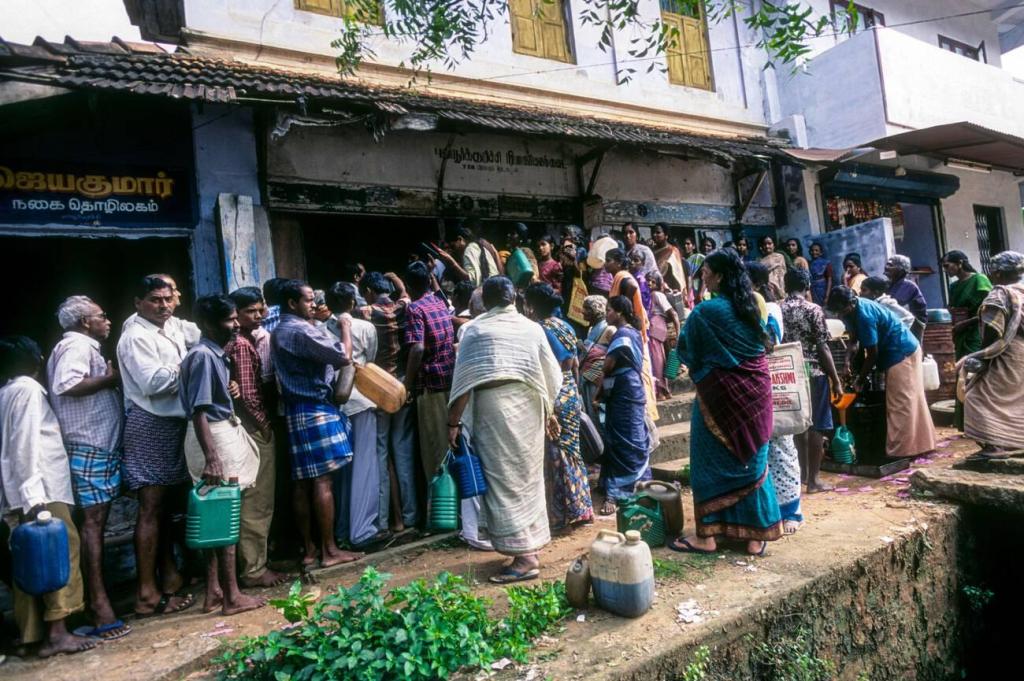
It’s a bright, humid morning in Tamil Nadu, and I find myself standing in a queue at my local ration shop, clutching my ration card like it’s a golden ticket to Willy Wonka’s factory. Except, in this case, the golden ticket doesn’t get me chocolates; it should get me rice, sugar, and oil—though that’s only in theory. In reality, it’s a tragic comedy, starring me and hundreds of others, all waiting for an outcome we already know: disappointment.
Tamil Nadu’s Ration Shop Experience – A Lesson in Patience and Prayer
Tamil Nadu’s Public Distribution System (PDS) is often praised as one of the best in the country. The state government provides free rice, subsidized groceries, and even palm oil that smells like something straight out of an auto repair shop. But there’s a catch: while these commodities exist on paper, actually getting them feels like trying to watch a Rajinikanth movie without gravity-defying stunts—highly unlikely.

Every month, the drama unfolds. First, the ration shop opens—but only when the shopkeeper feels like it. The timings fluctuate more than Chennai’s weather, and if you arrive too late, the shopkeeper’s default response is a shrug perfected by years of government service.
The Mysterious Case of the Missing Commodities
The government promises 20 kg of rice, but my neighbor swears she only gets 10 kg—unless she “convinces” the shopkeeper with a little extra incentive (hint: not respect). A performance audit by the Comptroller and Auditor General (CAG) highlighted leakages in Tamil Nadu’s PDS, with substantial stock vanishing before reaching consumers. The subsidized dal? A ghost item. The sugar? Either missing or resembling construction material.
The real showstopper is the cooking oil. Every month, the shopkeeper solemnly swears it hasn’t arrived. One day, my grandmother, a veteran of the PDS struggle, refused to leave without answers. After much back-and-forth, the shopkeeper finally pulled out a dusty bottle from under the counter—so ancient it might have been used during the Chola dynasty.
Digital Reforms – The Great Illusion
To address these issues, the government introduced biometric authentication, ensuring only rightful beneficiaries get their rations. But this is Tamil Nadu, where technology doesn’t interfere with “business as usual.” Fingerprint scanner? “Not working today, ma!” Online inventory system? “Server problem, sir!” Meanwhile, the shopkeeper’s friend has mysteriously stocked-up shelves at home.

Jean Drèze and Reetika Khera’s research highlights how biometric failures and digital fraud have excluded many rightful beneficiaries. The ambitious “One Nation, One Ration Card” scheme should, in theory, let me access my ration anywhere—even in Delhi. But considering I struggle to get it in my own neighborhood, the idea of seamless inter-state ration access seems optimistic at best.
The Bigger Picture – Hunger Amidst Plenty
Despite inefficiencies, Tamil Nadu’s PDS still ranks among the better ones in India. Other states don’t even put up the pretense of efficiency. But corruption, red tape, and mismanagement ensure that while food grains worth hundreds of crores rot in FCI godowns, many struggle to get their fair share.

The paradox is striking: India produces enough food, yet hunger remains a pressing issue. The Economic Advisory Council to the Prime Minister (EAC-PM) has pointed out the flaws in international hunger indices, arguing that India’s situation is often misrepresented. However, the real issue isn’t just about rankings—it’s about access. If Tamil Nadu’s relatively advanced PDS faces these hurdles, one can only imagine the situation elsewhere.
Where Do We Go From Here?
Reforms need to go beyond biometric systems. We need stricter monitoring, community-led audits, and a crackdown on middlemen diverting supplies. And maybe, just maybe, a ration shop employee who doesn’t act like they’re doing us a favor by handing out what’s rightfully ours.
Until then, the great TamilNadu ration shop saga continues—equal parts tragic, infuriating, and darkly hilarious. If you’re heading to your PDS store today, may the gods of ration stock be with you!
References:
- Comptroller and Auditor General of India (CAG). (2022). Performance audit of Public Distribution System in Tamil Nadu. Government of India.
- Drèze, J., & Khera, R. (2015). Understanding leakages in the public distribution system. Indian Journal of Human Development, 9(1), 1-11.
- Swaminathan, M. (2020). The public distribution system in India: Policy evolution and current issues. Economic and Political Weekly, 55(3), 22-28.
- The Hindu. (2023, October 10). Food grains worth Rs. 200 crores rotting in FCI godowns due to poor distribution network.
- Economic Advisory Council to the Prime Minister (EAC-PM). Reports on Hunger Index Methodology.
- von Grebmer, K., et al. (2023). Global Hunger Index 2023: Food Systems Transformation and Zero Hunger. Concern Worldwide and Welthungerhilfe.
 THE PUBLIC PODIUM